Glass
Window tint in San Jose, cut to each pane
Less heat, less glare and more privacy, with film fitted to every window on your car. Ask about shades before you choose one.
What tint fixes: heat, UV, glare and privacy
Glass is the part of a car that lets the most sun in. On a San Jose afternoon that means a cabin that cooks while it is parked, a steering wheel you cannot hold, and sunlight cutting straight across the dash and into your eyes. Window tint is a thin film bonded to the inside of the glass, and its job is to take the edge off all of that.
A good film cuts the heat that comes through the glass and blocks ultraviolet light, which is the same light that fades dashboards, seats and door cards over the years. It also knocks down glare, so the road is easier on the eyes, and it adds privacy, because people outside see a darker window and less of what is parked inside.
Different cars and different drivers want different things from it. A daily commuter may care most about heat and glare. Someone who leaves bags and gear in the back seat may care most about privacy. Say which one it is when you call (408) 813-7183 and the studio will point you at a shade that fits.
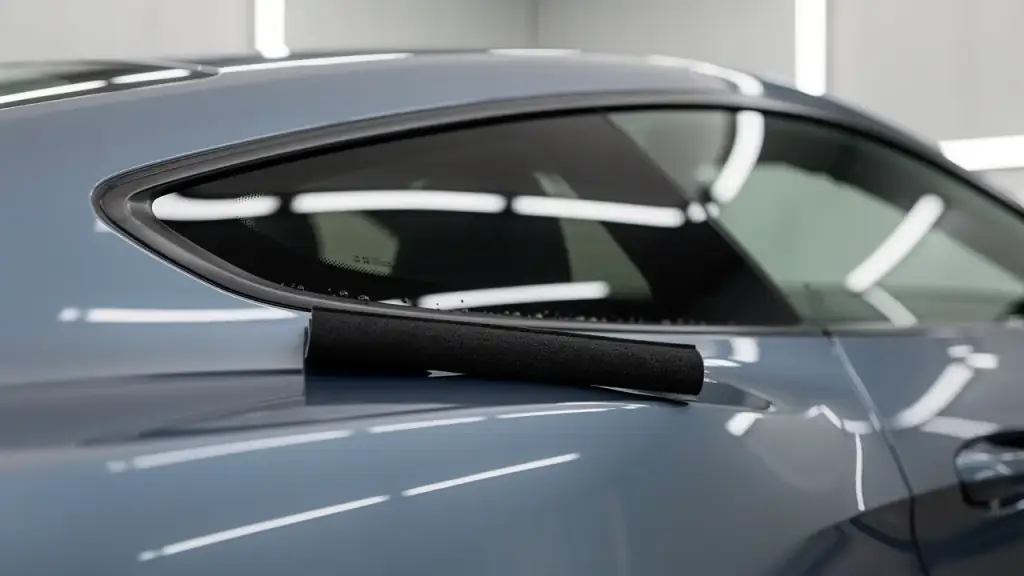
Rear quarter window carrying dark film, a felt squeegee resting at the lower edge of the glass
How film goes onto each pane of glass
The glass comes first. Film traps whatever is under it, so every window is cleaned until there is no dust, no old adhesive and no fingerprint left on the inside surface. A speck that gets sealed under film shows up as a bump for as long as the film lasts, so the prep is where a tint job is won or lost.
Film is cut to fit each pane, then positioned wet with a slip solution so it can be slid into place and lined up against the edges of the glass. A squeegee drives the water out from under the film in firm, overlapping passes, working from the centre outward until the film lies flat against the glass.
Curved glass, like the rear window on most modern cars, will not take flat film without wrinkling. The film is heat-shrunk to match the curve before it is laid down. That step is slow work and it is what separates a clean rear window from one with creased fingers of film along the edge.
Choosing a shade, then looking after the film
California has rules on how dark the front side windows and the windshield may be. Before you settle on a shade, ask. Rogers Detailing Studio will talk you through what is allowed for the glass on your car, so the shade you pick is one you can keep on the road.
New film needs time to cure. Moisture is still working its way out from between the film and the glass, and the film can lift or crease if a window is rolled down too soon. Leave the windows up for the period you are given at pickup, and expect a little haze or a few tiny water pockets that clear on their own as it dries.
After that, care is simple. Clean tinted glass with a soft cloth and an ammonia-free glass cleaner, and keep abrasive pads and stiff brushes away from the inside of the windows. The studio is at 1757 Lavonne Avenue, San Jose, open Monday to Friday, and a quote costs nothing.
Rogers Detailing Studio · 1757 Lavonne Avenue, San Jose · free quotes Monday to Friday